Macro-Political Stability Index: November 2026 edition
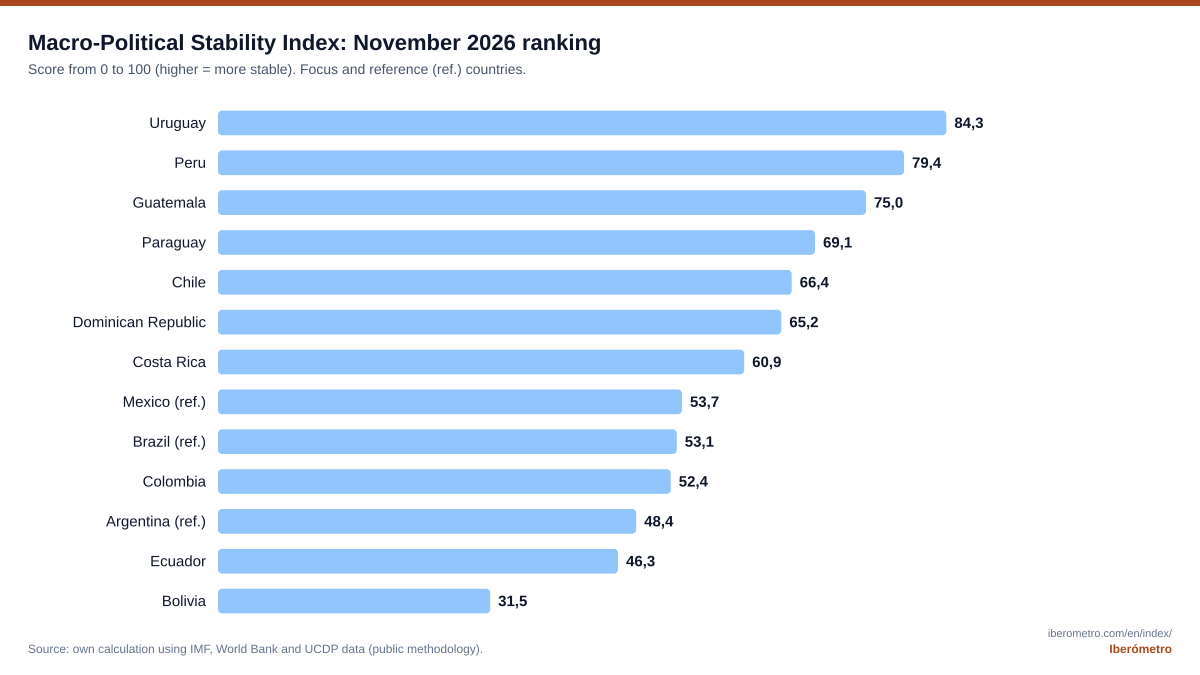
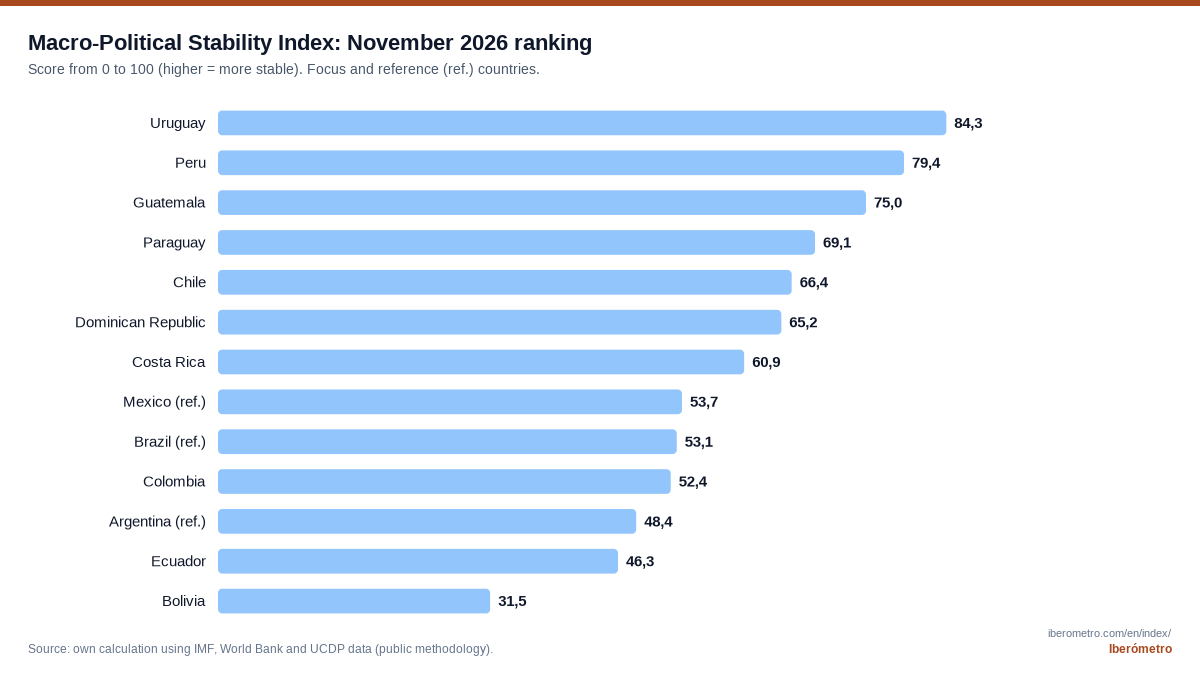
In the November 2026 edition of the Macro-Political Stability Index, the average of the 10 focus countries is 63.1 out of 100 (−0.4 points compared with the end of 2025).
Uruguay tops the ranking (84.3) and Bolivia comes last (31.5).
Compared with the end of 2025, the largest rise is Argentina (+4.9 points, mainly due to the monetary and external stability pillar) and the largest fall is Bolivia (−3.5 points, mainly due to the monetary and external stability pillar).
November 2026 ranking
| Rank | Country | Index | Change | Stability | Fiscal | Monetary and external | External liquidity | Political-institutional |
|---|---|---|---|---|---|---|---|---|
| 1 | Uruguay | 84.3 | −0.4 | High | 58.5 | 96.4 (−1.4) | 95.5 | 88.4 |
| 2 | Peru | 79.4 | 0.0 | High | 77.1 | 98.4 (−0.1) | 100.0 | 51.7 |
| 3 | Guatemala | 75.0 | −0.1 | High | 74.2 | 98.3 (−0.3) | 100.0 | 39.6 |
| 4 | Paraguay | 69.1 | −0.3 | Medium-high | 73.2 | 82.2 (−1.1) | 66.5 | 56.5 |
| 5 | Chile | 66.4 | −0.9 | Medium-high | 74.4 | 78.8 (−3.5) | 23.0 | 78.3 |
| 6 | Dominican Republic | 65.2 | +0.9 | Medium-high | 44.9 | 79.8 (+3.6) | 69.7 | 66.9 |
| 7 | Costa Rica | 60.9 | +0.4 | Medium-high | 33.5 | 83.6 (+1.6) | 64.0 | 62.9 |
| 8 | Mexico | 53.7 | +0.1 | Medium-low | 32.0 | 82.8 (+0.3) | 89.1 | 23.9 |
| 9 | Brazil | 53.1 | −0.1 | Medium-low | 16.2 | 89.4 (−0.3) | 62.1 | 47.6 |
| 10 | Colombia | 52.4 | −0.3 | Medium-low | 42.8 | 86.6 (−1.2) | 51.8 | 32.4 |
| 11 | Argentina | 48.4 | +4.9 | Medium-low | 67.5 | 52.1 (+19.7) | 0.0 | 61.6 |
| 12 | Ecuador | 46.3 | −0.1 | Medium-low | 67.5 | 79.9 (−0.6) | 0.9 | 30.8 |
| 13 | Bolivia | 31.5 | −3.5 | Low | 30.9 | 37.8 (−13.9) | 4.4 | 44.8 |
Embed or download this chart
You may reuse it with attribution (CC BY 4.0 licence). The image already includes the source and the site name.
Who rose
- Argentina: 48.4 (+4.9 points compared with the end of 2025; moves from position 12 to 11). The pillar contributing most is monetary and external stability (+19.7 points in the pillar).
- Dominican Republic: 65.2 (+0.9 points compared with the end of 2025; stays in position 6). The pillar contributing most is monetary and external stability (+3.6 points in the pillar). It is the highest value in its series since 2010.
Who fell
- Bolivia: 31.5 (−3.5 points compared with the end of 2025; stays in position 13). The pillar contributing most is monetary and external stability (−13.9 points in the pillar). It is the lowest value in its series since 2010.
- Chile: 66.4 (−0.9 points compared with the end of 2025; stays in position 5). The pillar contributing most is monetary and external stability (−3.5 points in the pillar).
Level changes and records
- Bolivia: 31.5, the lowest value in its series since 2010.
- Dominican Republic: 65.2, the highest value in its series since 2010.
A change of less than 0.5 points is treated as stable. The pillar contributing most is the one with the largest weight × change; each pillar and its indicators are explained in the methodology and on each country page.
Frequently asked questions
Which Latin American country is the most stable according to the index in November 2026?
Uruguay, with 84.3 points out of 100 (high stability). The lowest score is Bolivia’s (31.5). The index covers 10 focus countries and 3 reference countries (Argentina, Brazil and Mexico).
Which country rose most in the index in November 2026?
Argentina: 48.4 (+4.9 points compared with the end of 2025; moves from position 12 to 11). The pillar contributing most is monetary and external stability (+19.7 points in the pillar).
Which country fell most in the index in November 2026?
Bolivia: 31.5 (−3.5 points compared with the end of 2025; stays in position 13). The pillar contributing most is monetary and external stability (−13.9 points in the pillar). It is the lowest value in its series since 2010.
How often is an index edition published?
Every month, with the data available at the cut-off date. A month’s edition is frozen when the month ends and kept at its permanent URL. Each edition is compared with the previous one; the first with the end of the previous year. Methodology v0.
How to cite
Iberómetro (2026). «Macro-Political Stability Index: November 2026 edition». Data updated on 28 November 2026. https://iberometro.com/en/index/editions/2026-11/
To cite a specific figure, also give the country, the period of the data and the original source shown next to it. Licence for our own data: CC BY 4.0. More formats on the press page.